In 1975, my article ‘Raga, Species and Evolution’ appeared in Sangeet Natak, the journal of the Sangeet Natak Akademi, New Delhi, and in 1976 I was appointed as an assistant professor at the University of Groningen.

A booklet in Dutch about the sarangi was published on the occasion of Ram Narayan’s concert tour in the Netherlands in 1980, and a book about Indian music (also in Dutch) titled De Roep van de Kokila by Wim van der Meer and me appeared in 1982. A year later I interviewed several musicians in India and recorded their music for a six-part series, Meesters van de raga, I presented on the Dutch radio (KRO, Hilversum 4).
In September 1983 my son Dion was born, and at the end of the year I was appointed vice president of the International Society of Traditional Arts Research (ISTAR) in New Delhi. This society was established by the French computer scientist Bernard Bel (inventor of the Melodic Movement Analyser) and American researcher James (Jim) Arnold. I began working with D.C. Vedi (and his student Nupur Roy Chowdhury) on a project called Raga Sketches. The first issue of the ISTAR Newsletter was published in March 1984.
An agreement between ISTAR and the National Centre for the Performing Arts (NCPA) in Bombay (Mumbai) enabled collaboration in the field of scientific music research. Carried out by Bernard Bel and Wim van der Meer (and later on by Suvarnalata Rao), the main ISTAR-NCPA project focused on developing software for the Music in Motion project (which was later known as AUTRIM, i.e. Automated Transcription System for Indian Music).
Moreover, Dr. Kumud Mehta, director of the NCPA, invited me to write a monograph on the sarangi. I also developed a notation system for Hindustani music which was used later in The Raga Guide.
Back in the Netherlands in the summer of 1985 I had to face the hard reality of having to pay the rent and feed a child. With a few sarangi gigs here and there, and only one faculty position for ethnomusicology in the Netherlands, my future as a musician and musicologist was not very bright.
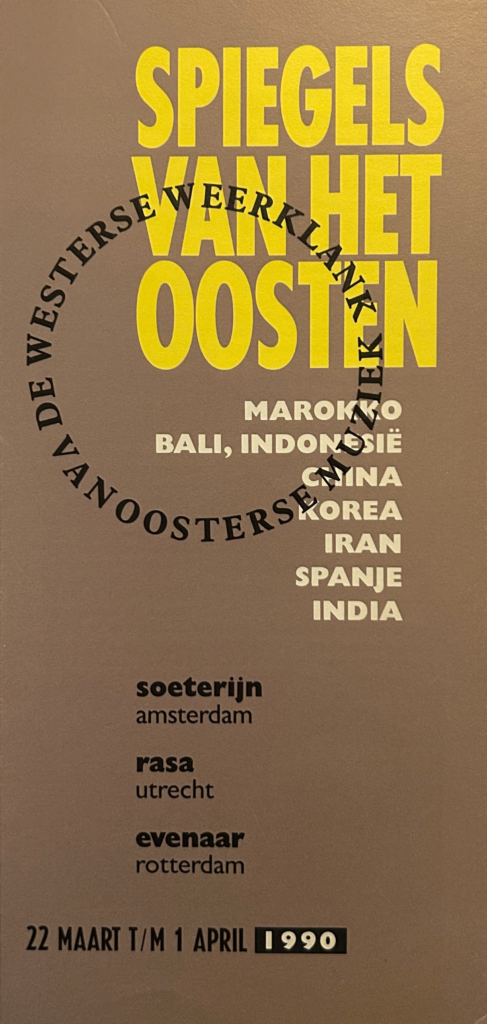
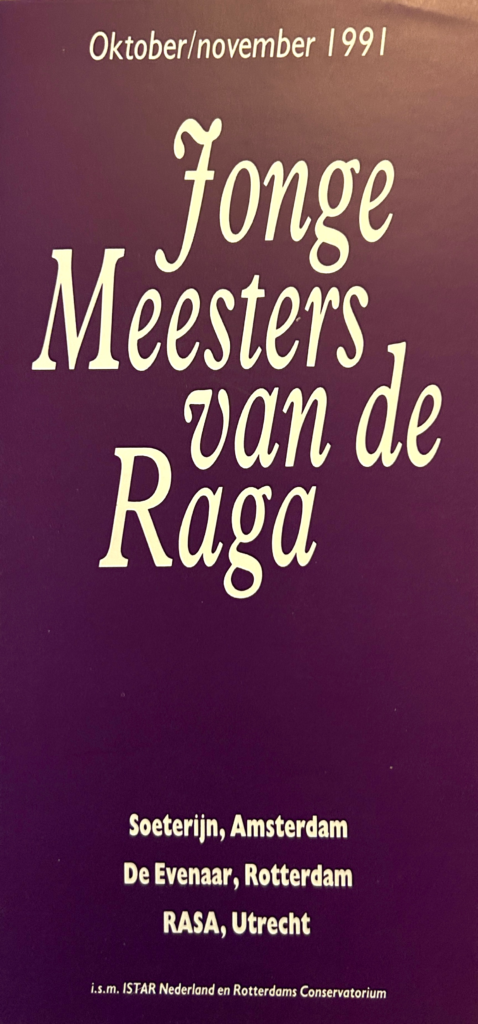
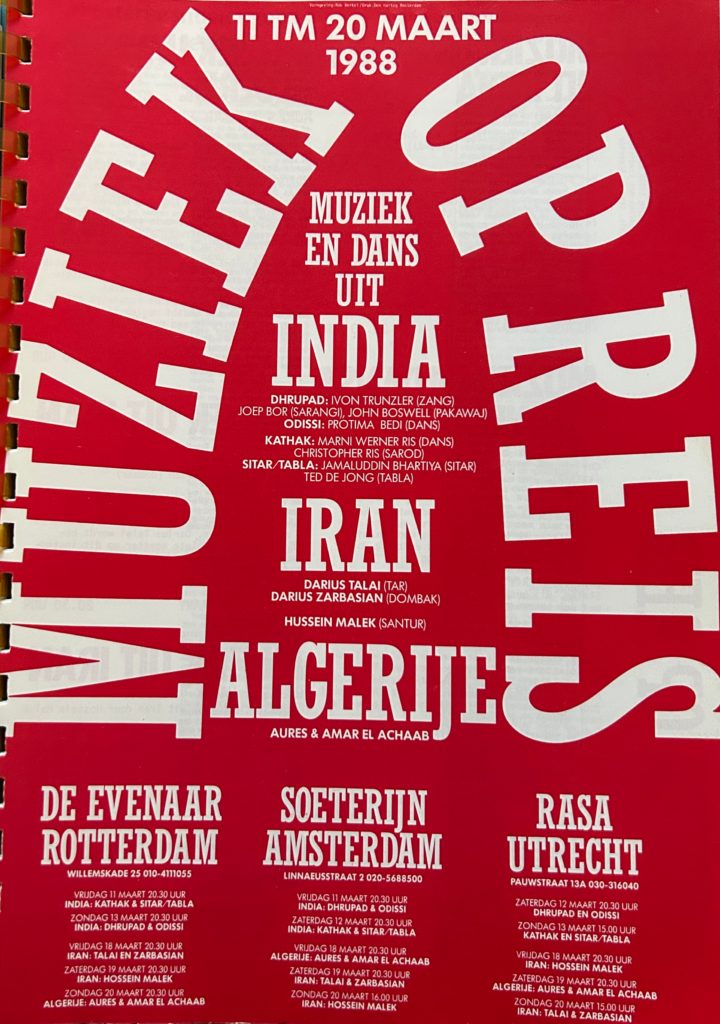
For this and other reasons I set up a foundation called ISTAR Nederland with several colleagues, applied for grants, and organized world music festivals like Spiegels van het Oosten (13-22 March 1987), Muziek op Reis (11-20 March 1988), another Spiegels van het Oosten (22 March-1 April 1990) and Jonge Meesters van de Raga (3 October-30 November 1991).

In September 1986 we opened the ISTAR School of Indian Music and Dance in an old, dilapidated school building in De Wittenstraat 100, Amsterdam, which was squatted by a group of alternative artists. We offered courses in Odissi dance, dhrupad and khyal singing, tabla, sitar and sarangi. The school attracted more than 70 students within a short period.